A town in south-western Lithuania, in Marijampolė County, which grew up around a railway station built in 1861. The municipality covers 555 km² and has four elderships. Population of the town at the beginning of 2026: 5 407.
The somewhat unusual place name Kazlų Rūda is a compound. The first part is explained by Baltramiejus Kazla, a nobleman from Mozūrija (Masuria) mentioned in the legend of the town’s founding, while Rūda (ore) is linked to the iron business he developed, which became the main trade of the area. The Kazlų Rūda coat of arms is also closely connected to the legend of the town’s origins and shares its motifs. The Kazla brothers are symbolised by six golden stars arranged between two roebuck antlers.
Kazlų Rūda is a town in south-western Lithuania, in Marijampolė County. The municipality covers 555 square kilometres and comprises four elderships: Antanavas, Jankai, Plutiškės and Kazlų Rūda. According to data from the beginning of 2026, the town of Kazlų Rūda has 5 407 residents.
Kazlų Rūda Municipality is one of the most densely forested areas in Lithuania. Forests cover 60 % of the municipality’s total area. Of the 555 km² total territory, 333,4 km² (33 343,1 ha) is forest land.
Most of these forests belong to us all: state forest land covers 29 058 ha, while private owners hold 4 285,1 ha.
10 7235 407 in the town5 316 in rural areasat the beginning of 2026
First mention
1737
Railway station
1861
To Marijampolė
27 km
To Kaunas
48 km
To Vilnius
148 km
History: 7 chapters
History timeline
Chapter 1
before 1861
The first mention
Kazla's tar works
The first mention of the town in historical sources is linked to Kazla’s tar works, for which Mrs Kazlienė herself paid the tax in 1737. This entry in the records of the Vilnius treasury is considered the beginning of Kazlų Rūda.
Chapter 2
1861
Railway station
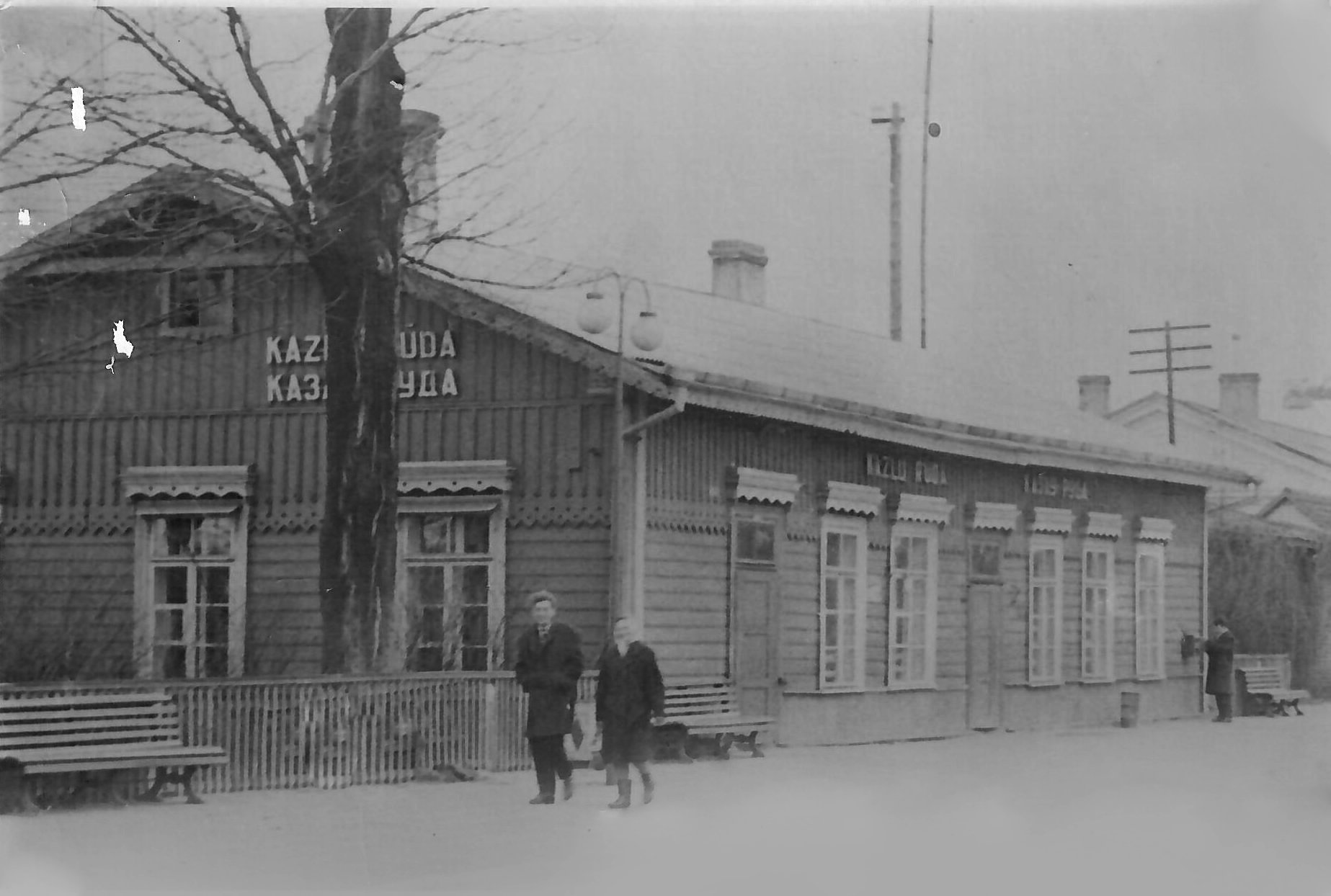
The station where the town begins
The old Kazlų Rūda railway station is, one could say, where the town’s history begins. The station is one of the oldest buildings in town. In 1861, when Tsarist Russia began building the Lentvaris–Virbalis railway, a small settlement began to take shape, with auxiliary railway buildings, houses for staff and an inn, also known as a traktierius, being built.
Somewhat later, the busy railway improved transport links, which also sped up the growth of the settlement. Several small shops opened, run by Jews who had moved here from other towns; markets were held, a primary school for the children of railway employees was opened, and a post office and a state savings and loan bank were established. Despite this, the settlement did not grow into a densely populated place before the First World War: until then, there were only about ten homesteads here.
1902 m. Kazlų Rūda
Chapter 3
1863–1864
Uprisings
Forests: a refuge for insurgents
The history of Kazlų Rūda cannot be separated from the period of the uprisings. The large, dense forests became a refuge for insurgents. They were quite active here, cutting down telegraph poles or tearing up railway tracks so that the enemy could not move by rail. Kazlų Rūda also saw more active clashes with the tsarist army, and one of the largest battles dates back to the uprising of 1863–1864. The armed clash took place near Čysta Būda, and 30 insurgents and their commander, K. Jastržembskis, were killed.
From the old press
“Trees, sandy stretches, moss and mushrooms. The road is empty and calm. The forest is as quiet as a shrine.”
A correspondent from Kaunas on Kazlų Rūda in the interwar period
Chapter 4
1915–1918
Imperial German occupation
Timber, berries and mushrooms
During the occupation by Imperial Germany, the Germans took note of the abundant forests of Kazlų Rūda and went into the timber business. A prisoner-of-war camp was set up next to the railway station. It held about three thousand prisoners of war, who did the logging work. It is estimated that about 1,5 million ktm. (kietmetris, a unit of timber volume used to calculate the amount of wood that fills a space of 1 m³ without gaps) were shipped to Germany. In addition, during this period Kazlų Rūda became known as the largest berry and mushroom collection point in Lithuania. Forest produce was exported abroad in barrels.
Chapter 5
1918–1940
The interwar period
A time when Kazlų Rūda flourished
The town was often called a resort, a wonderful place for holidaymakers arriving from the city in search of rest. The interwar period was a time when Kazlų Rūda flourished. In 1930, the Kazlų Rūda rural district was formed, comprising 63 villages grouped into 14 elderships. The town became a centre of trade and business. Its growth was further boosted by the construction of the railway branch line to Šeštokai: after Lithuania lost the Vilnius Region, that line was cut off, and Kazlų Rūda became an important railway junction. A power station was built, four sawmills operated and a Lithuanian primary school was founded.
In 1919, the Kazlų Rūda Forest Enterprise was founded, and as it developed, more and more people connected with forestry and the timber industry moved to the town from all over Lithuania. This is how the renowned forester M. Tumosas came to Kazlų Rūda. In 1922, the Kazlų Rūda parish was established. Later, a wooden church in a style unusual for Lithuanian sacred architecture was built. The house of worship has two towers and is decorated with forms imitating half-timbering. The church was dedicated to the Most Sacred Heart of Jesus.
1921 m. traukinių tvarkaraštis
Kazlų Rūdos panoraminė nuotrauka 1925 m.
Kazlų Rūdos miesto turgavietė 1930 m.
1930 m. Kazlų Rūdos restoranas
1935 m. Sėk
Chapter 6
1944–1990
The post-war and Soviet years
Difficult times
The difficult periods in Lithuania’s history did not pass Kazlų Rūda by, which is why the town has many monuments commemorating the stages of the country’s history. During the mass deportations, many residents of the Suvalkija region were deported to Siberia from the old Kazlų Rūda railway station. A monument to the victims of deportation was unveiled next to the old railway station in 1989.
During the Lithuanian partisan resistance against Soviet rule, one of the first partisan districts in Lithuania, the “Tauras” district, was formed in Kazlų Rūda. In total, six such partisan groups operated here. The famous partisan J. Lukša- Daumantas was active in the forests of Kazlų Rūda. A resistance memorial was erected in 2004 to commemorate the activities of resistance clergymen. The spirit of the national revival and the town’s support for the Reform Movement of Lithuania (Sąjūdis) are marked by the Sąjūdis memorial stone on M. Valančiaus St.
In 1950, the Kazlų Rūda district was established, comprising one small town and 12 rural areas. In the same year, Kazlų Rūda was granted town rights.
Kazlų Rūdos bažnyčia
1963 m. prie K.Griniaus gimnazijos
Miško kirtimas ~1965 metai
1966 m. vaikų dviratininkų varžybos Kazlų Rūdoje
1967 m. centrinė Kazlų Rūdos gatvė, Vytauto gatvė
1970 m. Kazlų Rūdos knygynas centrinėje gatvėje
Chapter 7
1990–present
Independent Lithuania
A small but welcoming town
After Lithuania regained its independence, the town of Kazlų Rūda became more attractive and was renewed: streets were improved, the old town centre was refurbished, and the service and retail sectors expanded considerably.
Kazlų Rūda is a small but welcoming town that continues to grow, develop and change at a rapid pace. It is one of the few towns in Lithuania that can boast well-preserved wooden architecture, and this is no coincidence: it is a land of forests, surrounded by the third-largest forest area in the country. Kazlų Rūda is still seen as a forest region to this day. The timber industry continues to thrive, and the town is home to a factory belonging to one of the world’s largest furniture manufacturers. Other industries are also present, including textile and metal production. The town is active in cultural, educational and learning activities. Tourism is important too. More and more people choose to unwind in nature, away from the hustle and bustle of the city, and this area is perfect for that. Kazlų Rūda offers visitors not only a rewarding time but also the luxury of being close to nature.
Būtini slapukai leidžia svetainei veikti. Kitus naudojame tik jums sutikus. Sprendimą galite pakeisti bet kada puslapio apačioje.
Būtini
Always active
Be jų svetainė neveiktų.
Nuostatos
Techninė saugykla arba prieiga yra būtina teisėtam tikslui išsaugoti nuostatas, kurių neprašo abonentas ar vartotojas.
Statistika
Google Analytics skaičiuoja, kiek lankytojų ir kokius puslapius jie skaito.Techninė saugykla arba prieiga, kuri naudojama tik anoniminiais statistikos tikslais. Be teismo šaukimo, jūsų interneto paslaugų teikėjo savanoriško įsipareigojimo ar papildomų įrašų iš trečiosios šalies, vien šiuo tikslu saugoma ar gauta informacija paprastai negali būti naudojama jūsų tapatybei nustatyti.
Išorinis turinys
Žemėlapio fragmentai iš OpenStreetMap ir vaizdo įrašai iš kitų svetainių.