Business: For Beginners
Starting a Business
One way to do your dream job is to create it yourself. You do not need a university degree or a huge investment: the most important thing is knowing how and where to start.
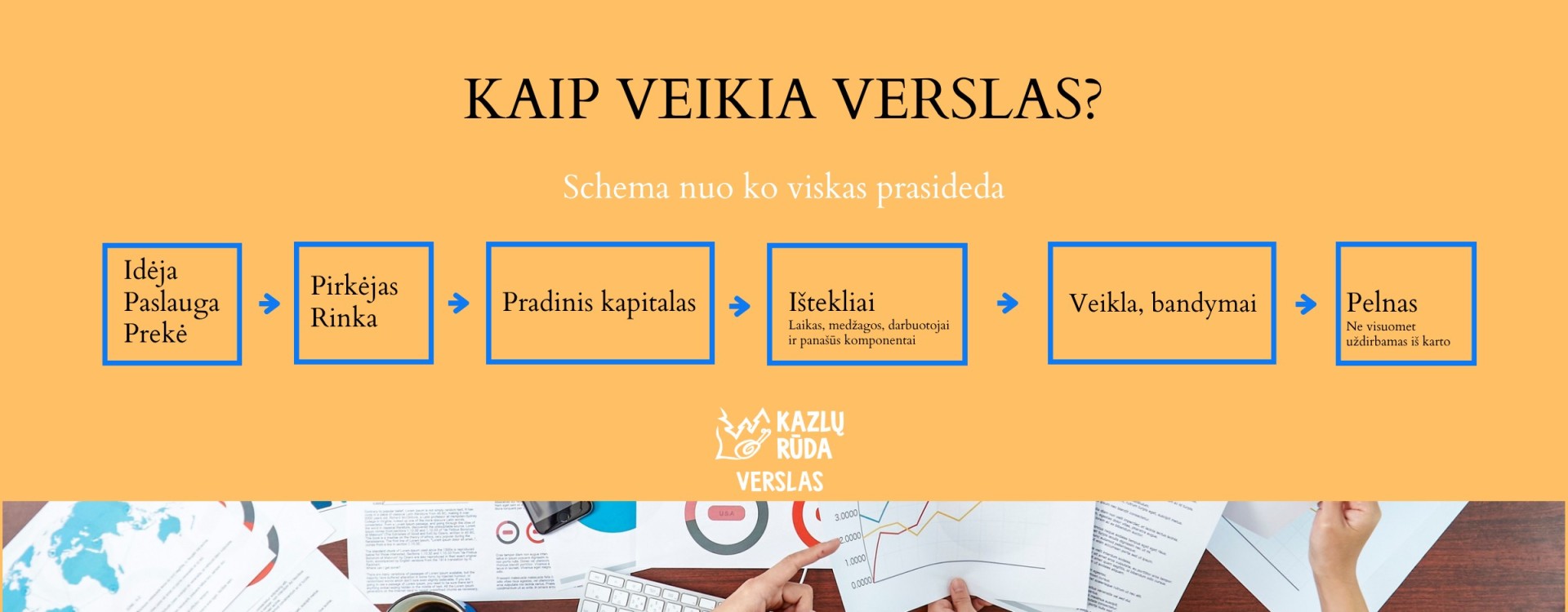
1 Come up with an idea or put an existing one into practice.
Hundreds of business ideas may come to mind in a single day, but focus on two possible options:
- your idea should be innovative, offering something that is not yet on the market, or
- your idea should do something better, faster, more cheaply or the like than existing competitors.
Nowadays it is difficult to come up with a completely new business idea, so people more often choose to adapt an existing idea in their own way. The most important thing is that you like it, because running your own business involves a lot of responsibility, and you will only stay motivated in the long run by doing something that genuinely interests you.
Think about what you enjoy doing and what your hobbies or strengths are. If you are short of ideas, pay attention to everyday problems and market needs: solving them often becomes the foundation of a successful business.
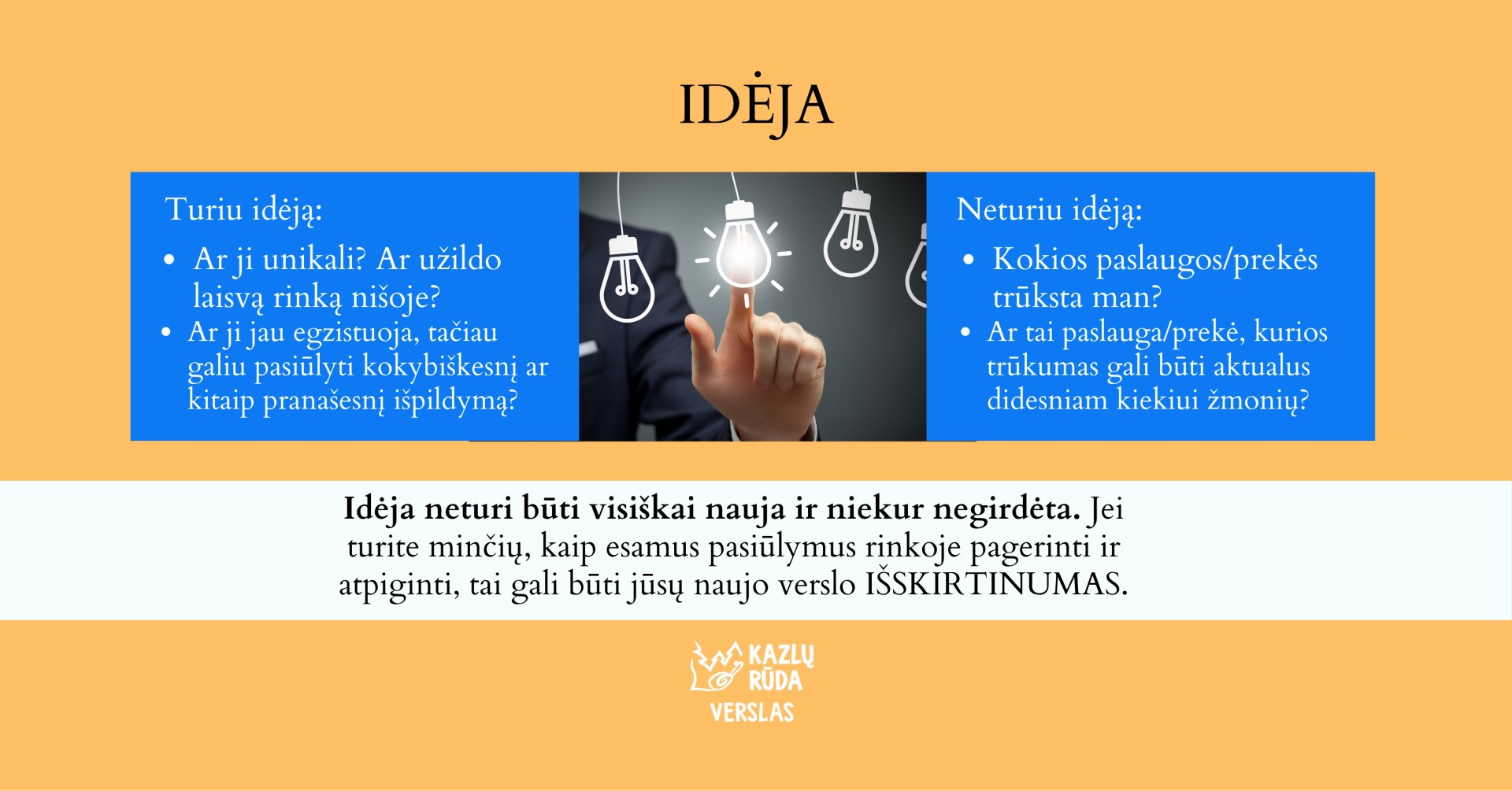
2 Research the market.
Even the best idea will not succeed if there is no demand for it on the market. That is why, before you start, it is important to find out whether your product or service is really needed. For initial market research, it is enough to survey friends, acquaintances or potential customers, or to share your idea on social media or in communities.
Listen to constructive criticism, pick out the valuable advice and refine your idea. Also analyse your competitors: watch what they do well and think about how you could stand out.
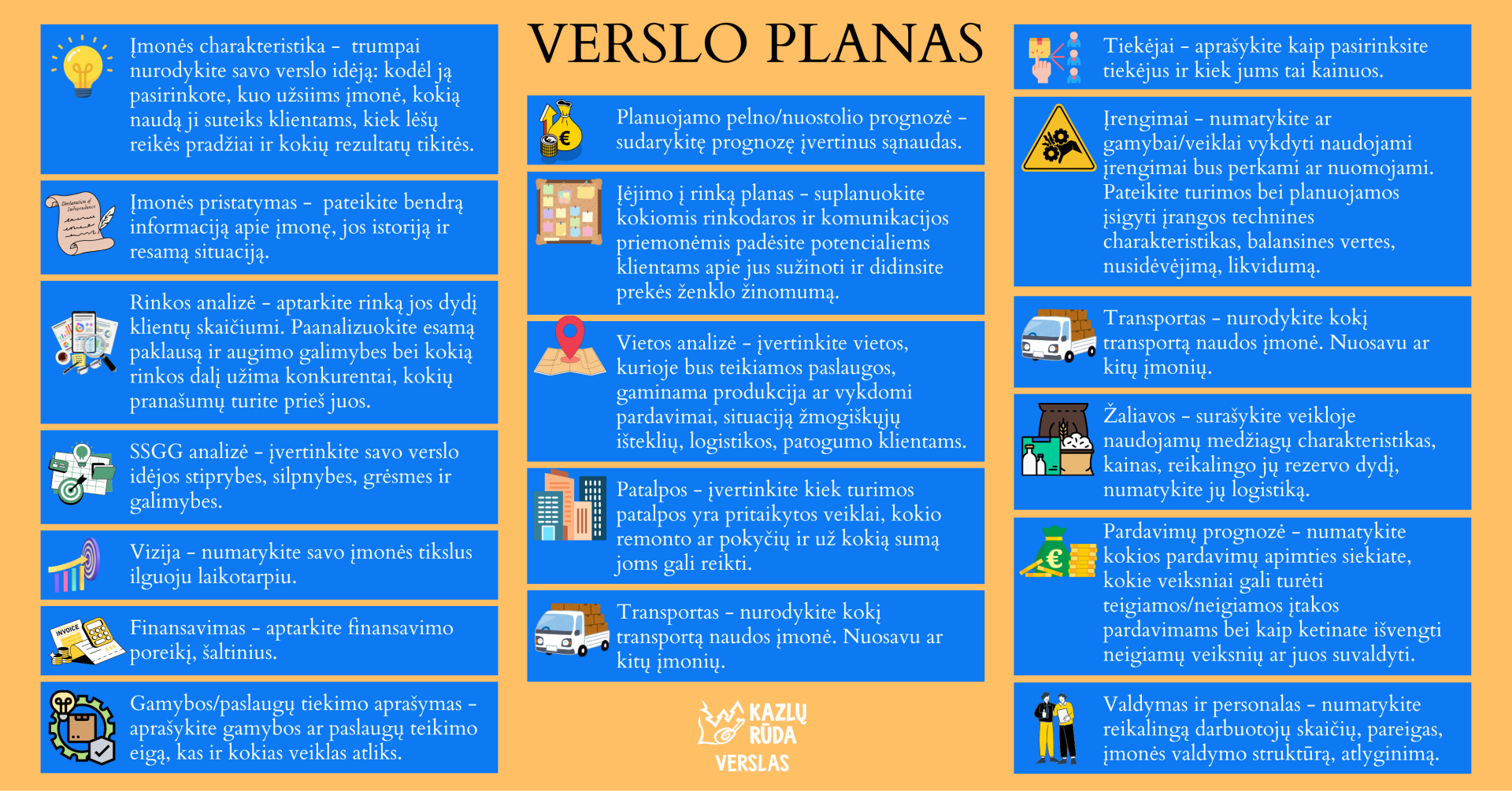
3 Draw up a business plan.
A business plan helps you set out clear goals and actions and assess possible risks. Without one, building a business may take more time, effort and financial resources. In the plan, briefly describe your business idea, the products or services you offer, your target market and the value you create for customers. Assess the size of the market, your competitors, and your business’s strengths, weaknesses, opportunities and threats (SWOT).
Also estimate your funding needs, projected income, expenses and cash flow. Consider how many employees you will need, how operations will be organised and what skills your team will require. Do not forget about marketing either: even a great idea will not succeed if potential customers never hear about it. Plan in advance how you will reach your audience and present your business.
Once your business idea and business plan are ready, it is time to set up your business and make sure it is managed effectively.
Business Forms in Lithuania: Which One to Choose?
When starting a business in Lithuania, one of the most important decisions is choosing the right legal form. The form you choose will determine the tax system, the level of liability, how complex the setup is and the management structure.
Business forms you can choose from:
A small partnership is a private legal entity with limited liability: its members are not liable with their personal assets for any unfulfilled obligations of the small partnership. A small partnership may be established by no more than 10 natural persons (there may also be a single founder).
A private limited company (UAB) is a private legal entity with limited liability: its shareholders are not liable with their personal assets for any unfulfilled obligations of the UAB. The authorised share capital of a UAB must be at least 1000 Eur. A UAB may be established by one or more natural and/or legal persons, and there is no limit on the number of shareholders.
An individual enterprise (IĮ) is a private legal entity with unlimited liability: the owner is liable with their personal assets for any unfulfilled obligations of the IĮ. An IĮ may be founded and owned by only one natural person, who may not own another IĮ.
A public institution (VšĮ) is a non-profit public legal entity with limited liability whose purpose is to serve the public interest by carrying out activities that benefit society. A VšĮ may be established by one or more natural and/or legal persons, and there is no limit on the number of founders.
An association is defined as a public legal entity with its own name and limited civil liability, whose purpose is to coordinate the activities of its members, to represent and defend their interests, or to serve other public interests.
Business form | Liability | Founders / members / shareholders | Main conditions / purpose |
|---|---|---|---|
Small partnership (MB) | Limited liability: members are not liable with their personal assets for any unfulfilled obligations of the MB. | 1–10 natural persons. | There may be a single founder. There may be no more than 10 members. |
Private limited company (UAB) | Limited liability: shareholders are not liable with their personal assets for any unfulfilled obligations of the UAB. | 1 or more natural and/or legal persons. No limit on the number of shareholders. | The authorised share capital must be at least 1 000 Eur. |
Individual enterprise (IĮ) | Unlimited liability: the owner is liable with their personal assets for any unfulfilled obligations of the IĮ. | Only one natural person. | The owner may not own another IĮ. |
Public institution (VšĮ) | Limited liability. | 1 or more natural and/or legal persons. No limit on the number of founders. | A non-profit legal entity whose purpose is to serve the public interest by carrying out activities that benefit society. |
Association | Limited civil liability. | 3 or more natural and/or legal persons. | A public legal entity whose purpose is to coordinate the activities of the association’s members, to represent and defend their interests, or to serve other public interests. |
When starting a business, you can never have too much knowledge. Business consultations are provided by a range of public and private institutions.
More information on setting up a company, choosing a legal form, the registration procedure and tax obligations can be found in the section of the State Tax Inspectorate (VMI) website ‘Steigiu įmonę’ (Starting a Company).
In Kazlų Rūda, information is provided by:
- Virginija Petrukaitienė, accountant at VšĮ Kazlų Rūdos turizmo ir verslo informacijos centras
- Tel.: +370 61693342
- Email: buhalterija@visitkazluruda.lt
Consultation on choosing a business form | h | 25,- | An initial consultation of up to 1 h is free of charge; further consultations are charged at 25 Eur/h. |
Consultation on various accounting matters | h | 30,- | An initial consultation of up to 1 h is free of charge; further consultations are charged at 30 Eur/h. |
Business
More for business
Business consultations
Your first guide to business
Whether you are looking for the right place to invest, are interested in support programmes or would like advice on growing your business, we will help you find the answers you need and put you in touch with the key municipal institutions.
Contact person
Rūta Kondratienė
Director
- +370 613 98318
- vadyba@visitkazluruda.lt
- Mon–Fri 9:00–17:00, lunch break 12:00–13:00