In 2023, the project “A Journey Through Time Along the Royal Railway Route”, carried out by the Kazlų Rūdos turizmo ir verslo informacijos centras and the Olecko regioninis kultūros centras “Mazury Garbate”, invited people to discover the old buildings of Kazlų Rūda and Oleckas. This time, we invite you on a journey through time: a stroll along the streets of Kazlų Rūda, stopping at each of the five historic town buildings selected for the project.
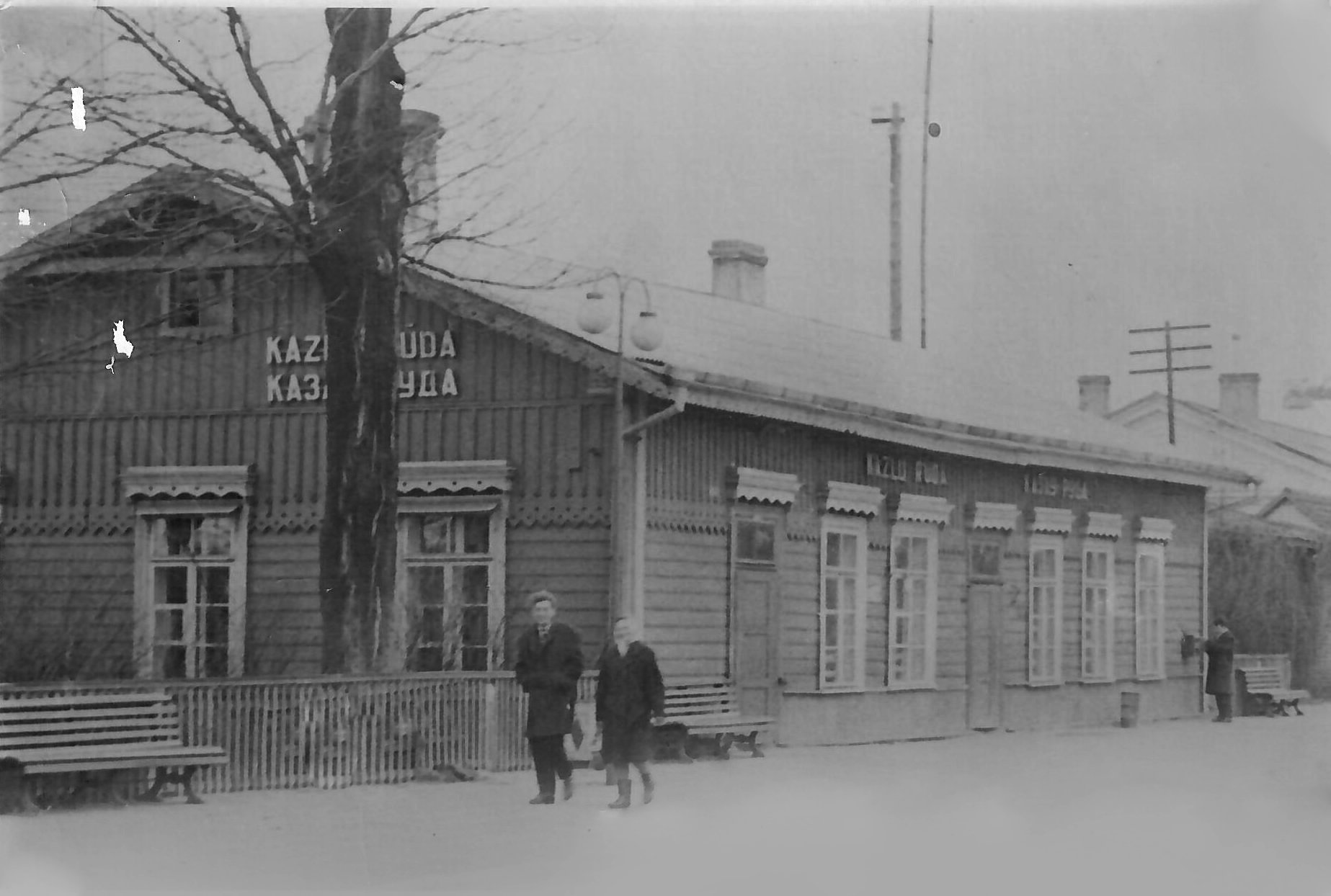
Let us begin our walk in 1861, when a 162-verst (173 km) branch line, Lentvaris-Kaunas-Virbalis-Eitkūnai, was laid from the existing Sankt Peterburgas-Varšuva railway line. That same year saw the construction of the oldest building still standing in Kazlų Rūda: the railway station, located just over 2 km from what was then the village of Kazlų Rūda. According to written sources, before the First World War there were about 11 homesteads in Kazlų Rūda besides the railway station building. Moving forward a few decades, Kazlų Rūda had changed beyond recognition and become an unofficial Lithuanian resort, so newspapers of the time carried reports on preparations for the holiday season: “The railway station is sprucing up its square facing the dusty main street, whose trees are edged with turf on one side and whitewashed pebbles on the other. Towards the park, that is, the pine forest, the summer houses are being aired and painted”, “Lietuvos aidas” (25 May 1936, P.6). Written sources tell us that holidaymakers from Marijampolė, Virbalis, Vilkaviškis and Kaunas came to Kazlų Rūda by train. It is said that every Sunday, day-tripping adventure seekers arrived in Kazlų Rūda from Kaunas. “Dates and meetings were arranged on the station platform. In the evenings, hundreds of people would meet or see off every train. The platform was the scene not only of romantic encounters but also of settling scores over old grudges or insults.” (online newspaper “Santaka”, 8 April 2020, “The Famous Past of the Town of Kazlų Rūda”, by Tomas Sušinskas). The old spirit of the station can still be felt by visiting the surviving building, which now houses the town bar “Peronas”, which, just as in days gone by, has become a place where locals and visitors meet and go on dates.
We continue our journey through time just across the street from the station building, where in 1910-1911 the old Vilkaviškis railway station building was brought in parts from Vilkaviškis and thus became the first two-class school in the settlement of Kazlų Rūda. The school belonged to the railway administration, and its premises housed classrooms and flats for teachers. It also had a boarding house, which in 1913 was home to 60 children of railway workers. The school operated until the First World War. During the war, a hospital was set up in the building. After the war, the railway workers’ school operated for only two years. The police were temporarily based in the building, and later it was handed over to residents. On 23 January 1923, the Marijampolė County Education Commission adopted a resolution to establish a primary school in Kazlų Rūda. The railway administration provided two rooms: pupils of the first, second and third forms studied in one, while the head of the primary school, Kazimieras Bukšnys, lived in the other. The post office was located on the ground floor. Later, as the number of pupils grew, families were moved out of the premises and the school was given the entire first floor. By 1926, the school already had 6 forms. In 1939, the school had seven forms, the seventh of which was vocational. In 1941, the building burned down, and a brick residential house was later built in its place, which still stands today.

While the school was still operating, roughly between 1932 – 1937, another interesting building went up on the same street. It became the home of a young, newly married couple: Benjaminas Gudaitis and Magdelena Štrimaitytė-Gudaitienė. Benjaminas worked as a forester in Kazlų Rūda. Magdelena had been disabled since childhood, so she kept house. The couple never had children of their own, and so throughout their lives they were very attentive to their nieces and nephews and looked after them. Magdelena, or Magdelė, as she was known not only to the people of Kazlų Rūda but also to visitors, was a herbalist. She specialised in, and sold, just one medicinal herb, tormentil, which she herself called “vėžiukai” (“little crayfish”). People say that Magdelė truly looked “witch-like”, in the very best sense of the word. In her later years Magdelė could no longer walk and used a wheelchair. Small in stature, hunched over, with contracted legs that had been unhealthy since childhood and twisted finger joints, Magdelė never complained. She always radiated light and kindness, had a very calm nature and was a good listener. She would talk at length with everyone who came to see her, ask about all their troubles and sincerely try to help. Magdelena’s house always looked distinctive. The front door was on the courtyard side, right in the middle of the house. It opened into a corridor that divided the house into two halves. At the end of the corridor was a staircase to the first floor. At the front of the corridor, on the left and on the right, doors led to the living quarters. Magdelė’s rooms were on the right. As soon as you stepped in, you found yourself in a small kitchen with an old stove with hob rings. From the kitchen, doors led to two further rooms. One was very large, and this is where Magdelė received people; the other, smaller one was the bedroom. The other side of the house had a similar layout, but it was used less often and served as a storeroom (a place or room for putting away and keeping things). The house had large rooms, fairly high ceilings and windows that were unusual for the time. Upstairs there were two small rooms with low ceilings and a small kitchen. For a while, Magdelė let this space to young families. The house now belongs to other owners.

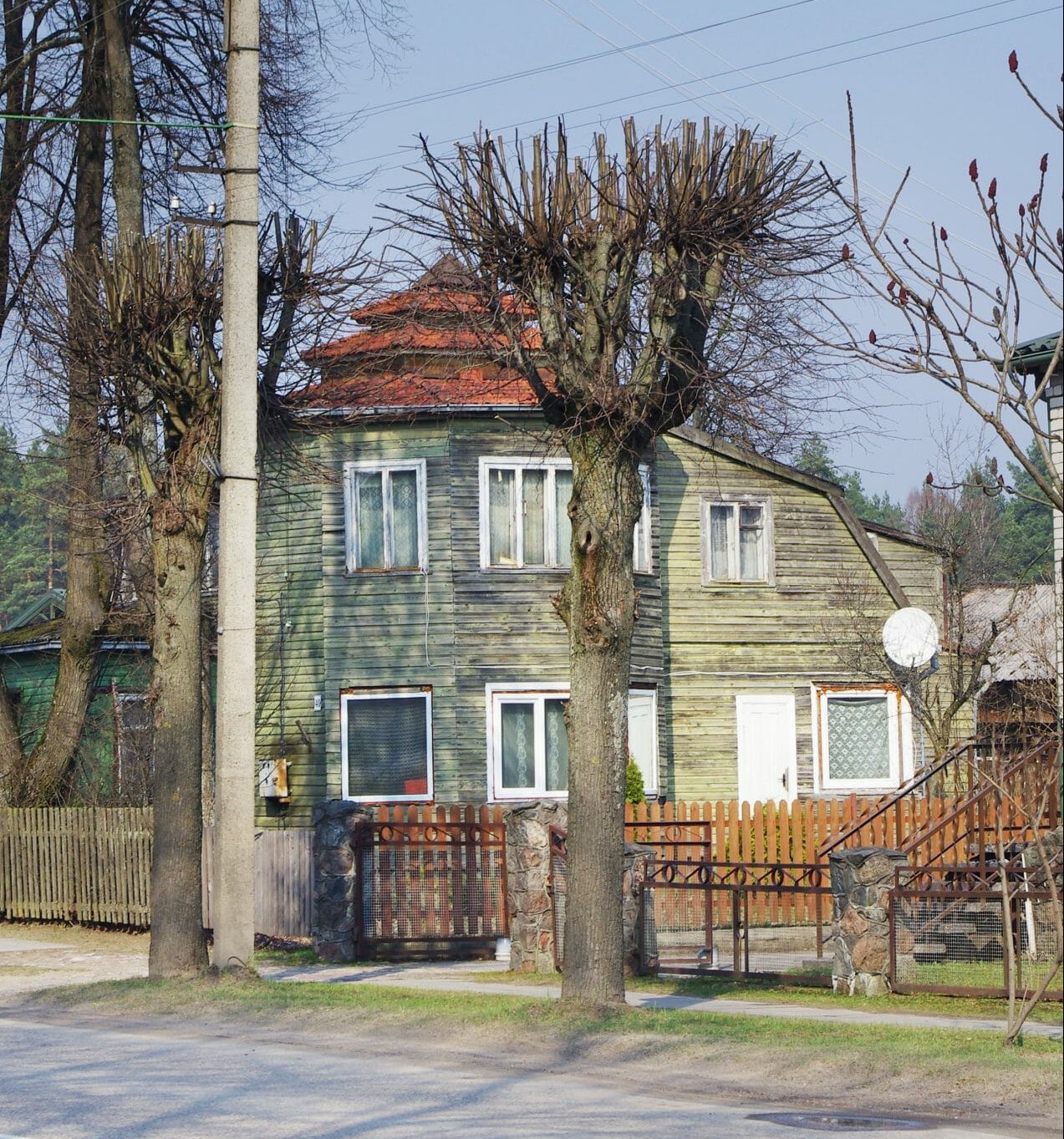
Around the time Magdelė and her husband settled in Kazlų Rūda, another house was completed on Vytauto Street. As the forestry administration was actively expanding its work, the house became home to people connected with the forest and the timber industry: the Tumosas family. The forester Martynas Tumosas started his life here together with his family. They built the house to a design by a German architect, and construction was completed in 1933. Martynas Tumosas himself worked at the Runkių girininkija (forest district) of Jūrės miškų urėdija from 1929-1939, served as head of Jūrės miškų urėdija from 1944-1945, and from 1945-1947 was director of Kazlų Rūdos miško pramonės ūkis, the local forest industry enterprise. Marijona Tumosienė kept house. According to the recollections of her contemporaries, she was a woman of exceptional beauty and elegance. Everyone on the street recognised her from afar by her stylish clothes and proud bearing. It is believed that Tumosienė ran a beauty salon from her home. It is also known that the Tumosas family had a large plot of land beside the house with a remarkable garden, which the elder Tumosas tended with particular care. It contained imported fruit trees: apricots, peaches and fine varieties of pears and apples. Over the house’s long history, many different people have lived here. Today the house is owned by two families, with the larger part belonging to the descendants of the Tumosas family.
The last building on our journey no longer exists, yet its history holds two separate stories. The first tells us that this building originally housed the Plaušinis restaurant, one of four restaurants operating in Kazlų Rūda at the time. Guests were served by men, as the clientele was almost exclusively male, and the menu featured meat patties, beefsteaks, schnitzels and sausage with various sides. The building belonged to Jewish owners and had a characteristic architectural feature: the entrance was on the corner, so that foot traffic from both streets was drawn in equally. Later, a bookshop occupied the ground floor, while people lived on the floor above. The bookshop had two rooms: a small storeroom and a sales hall with shelves on which books were sorted by genre. It sold all kinds of literature, children’s books, dictionaries and encyclopaedias. When a new delivery of books arrived, the queue of eager buyers stretched along a good part of Vytauto Street, and the most determined would start waiting from 6 a.m. Besides books, the shop also sold school supplies, lottery tickets and flowers, which came from a local nursery. On International Women’s Day the flower trade was so brisk that the bookshop door barely closed for the stream of male customers. In the winter of 1997, a fire broke out in the flat on the first floor above the bookshop. Although the fire was put out quickly and successfully, the bookshop ceased trading and was eventually closed. Later still, the building was privatised and finally demolished.

With this project, Kazlų Rūdos turizmo ir verslo informacijos centras hopes to bring back to life the stories of buildings and of the people who lived in them, growing up alongside the town. Thanks to the stories gathered here, a walk along the main streets of Kazlų Rūda can work like a time machine, letting you sense the spirit of past eras and the meaning of the town’s historical path.